Comparing Approaches to Planning product inspections in China
Inspection approaches differ in what they can observe and when they can affect the outcome. Document review can flag evidence gaps, process observation can reveal control problems, sample checks can assess selected product features, and shipment inspection can verify defined lot conditions. Buyers should compare coverage, method, timing, and decision value before selecting one or combining several.
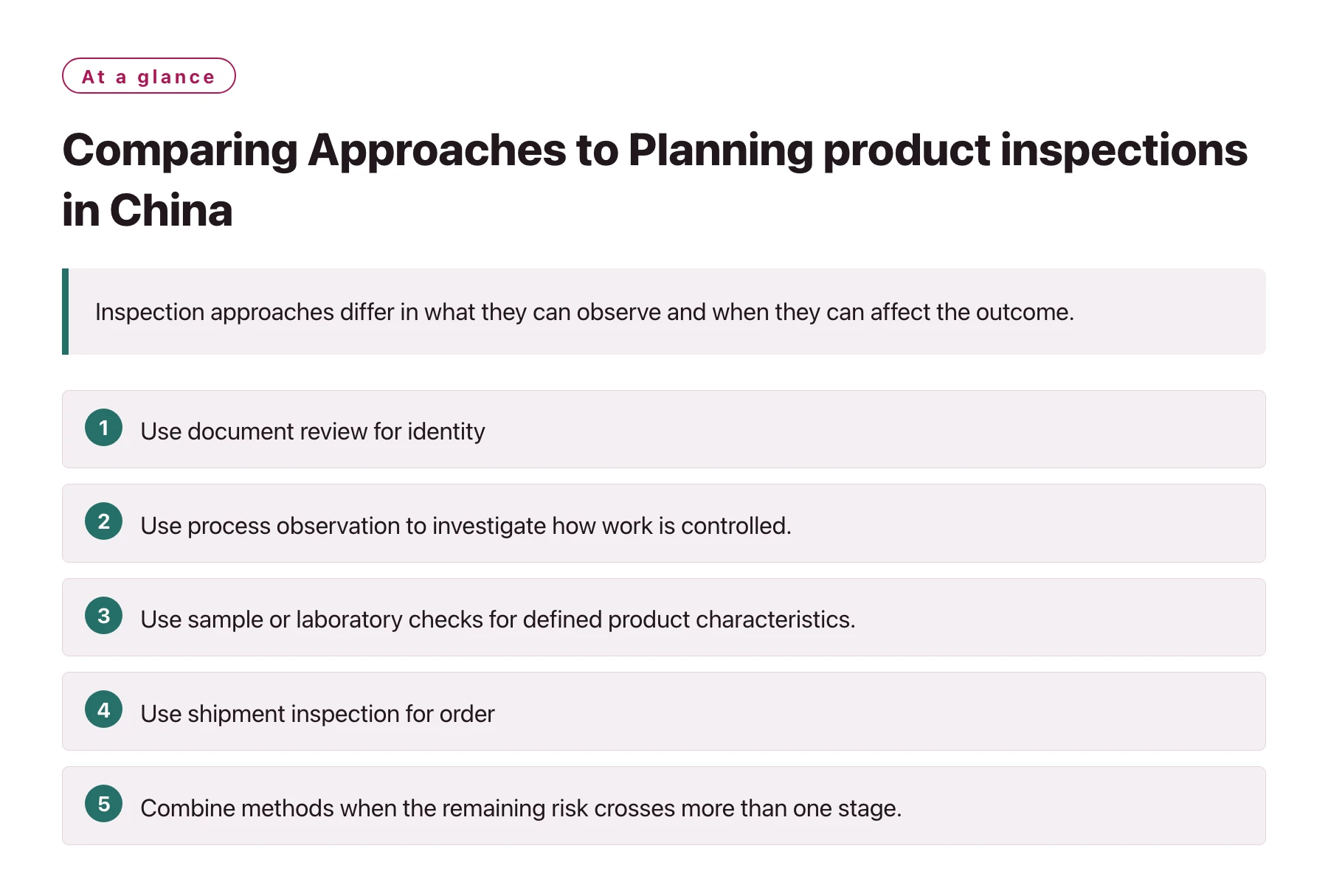
Key takeawaysUse document review for identity, scope, revision, and evidence checks. · Use process observation to investigate how work is controlled. · Use sample or laboratory checks for defined product characteristics. · Use shipment inspection for order, lot, packaging, and visible acceptance criteria. · Combine methods when the remaining risk crosses more than one stage.
No single inspection type provides complete assurance; choose methods according to the product question and the action available after a finding.
1. Define the question each method should answer
Start with the decision: approve a factory, verify a process, test a characteristic, accept a lot, check packing, or document loading. Identify the product, revision, intended use, market, lot, and consequence of a wrong decision. State which uncertainty is most important to reduce.
Separate supplier-system evidence from product and shipment evidence. A certificate, audit, test, and final inspection answer different questions. They should not be ranked as interchangeable simply because each produces a report.
2. Compare document review and remote evidence
Document checks can verify quote, drawing, specification, certificates, declarations, test reports, labels, and traceability records without a site visit. They are useful for screening identity, revision, date, issuer, scope, and obvious gaps.
Their limit is that documents may not show actual factory conditions or current production. Verify authenticity where possible and connect evidence to the exact product, site, revision, and market. Request follow-up when reports are generic, expired, incomplete, or inconsistent.
3. Compare supplier audit and process assessment
A supplier audit or process review examines defined management controls, material handling, instructions, equipment, training, traceability, nonconforming product, and corrective action at a point in time. It can help explain recurring issues or evaluate a new manufacturing site.
Scope, duration, records sampled, process access, and auditor competence matter. A system-level review does not prove that a specific product or lot conforms. Ask how findings are rated, corrected, verified, and linked to buyer requirements.
4. Compare pre-production and first-off checks
Pre-production checks can confirm material, tooling, approved sample, revision, work instruction, and readiness before volume work begins. First-off review evaluates early output from the current setup and may uncover interpretation or process problems while limited quantities are affected.
These checks require timely access and clear stop or restart authority. They do not automatically cover later process drift, shift changes, subcontracting, or final packaging. Define what evidence triggers continuation and what requires correction before broader production.
5. Compare during-production and final inspection
During-production observation can identify recurring defects, mixed materials, process shortcuts, or schedule risk before the run is complete. Final inspection evaluates selected finished goods, packaging, quantity, labeling, and specified functional or dimensional criteria before shipment.
The best stage depends on when issues can be corrected and when products are accessible. A final visit is too late for some process problems; a mid-run check may not represent finished goods. Combining stages can be justified when product risk and history support it.
6. Compare sampling and specialized testing
Sampling provides a decision about a lot based on selected units and stated criteria. ISO 2859-1:2026 describes AQL-indexed sampling procedures for inspection by attributes where applicable. Define lot, edition, inspection level, sample selection, and acceptance rules; understand the residual risk because not every unit is examined. [1]
Laboratory or specialist tests answer specific material, physical, chemical, microbiological, or performance questions using defined methods. Confirm competence, sample custody, test scope, configuration, and criteria. A test report does not necessarily cover a changed product or future lot.
7. Compare loading and logistics checks
Loading supervision can verify selected shipment identities, quantities, visible packaging, container condition, loading sequence, and seal details. Freight tracking or document review can follow a shipment’s movement or paperwork. These controls focus on handoff and transport rather than full manufacturing conformity.
Define which observations matter, what photographs are required, and how shortages or damaged goods are handled. Loading evidence cannot establish hidden product properties or undo a defect that passed earlier controls.
8. Compare coverage, timing, and total cost
Build a matrix for question, scope, timing, method, sample basis, evidence, limitations, lead time, cost, and decision owner. Include travel, laboratory, sample shipping, retest, corrective action, and schedule impact. Compare methods under the same product and market assumptions.
A low-cost method may leave a material risk unanswered; a broad audit may be inefficient for a one-time lot count. Consider where the finding can still change the outcome. Prioritize checks before the last practical correction or shipment release point.
9. Combine methods and define escalation
Use layered assurance when risks span design, process, product, and logistics. For example, document verification plus process observation and final lot checks may address different gaps. State how one result influences the next step and when a specialist or additional test is needed.
Define pass, fail, pending, and not verified states. Assign containment, corrective action, reinspection, concession, and release authority. Keep critical findings visible to procurement, quality, technical, and logistics teams.
10. Review performance and adjust the approach
Compare inspection findings with receiving defects, claims, complaints, rework, and supplier history. Determine whether the method found issues early enough and whether its limits were understood. Record unnecessary checks as well as missed risks.
Buyers comparing JS Sourcing inspection services in China can choose a combination based on product risk, supplier performance, market, and available correction time. Reassess after a new site, process, product, requirement, or significant deviation rather than copying last year’s inspection plan automatically.
Sources
Frequently asked questions
Can a supplier audit replace pre-shipment inspection?
No. An audit reviews defined systems; a pre-shipment check evaluates selected goods and criteria for an order.
When are laboratory tests more useful than visual checks?
Use them when a defined material or performance property requires a suitable technical method.
Does a final inspection cover hidden production risks?
Not necessarily. It may miss issues inaccessible in finished goods or created at earlier process stages.
Should every shipment use the same inspection approach?
No. Adjust for product risk, supplier history, market, process stability, and available corrective time.