Is Eco-Friendly Wholesale Coffee Packaging Right for Your Business?
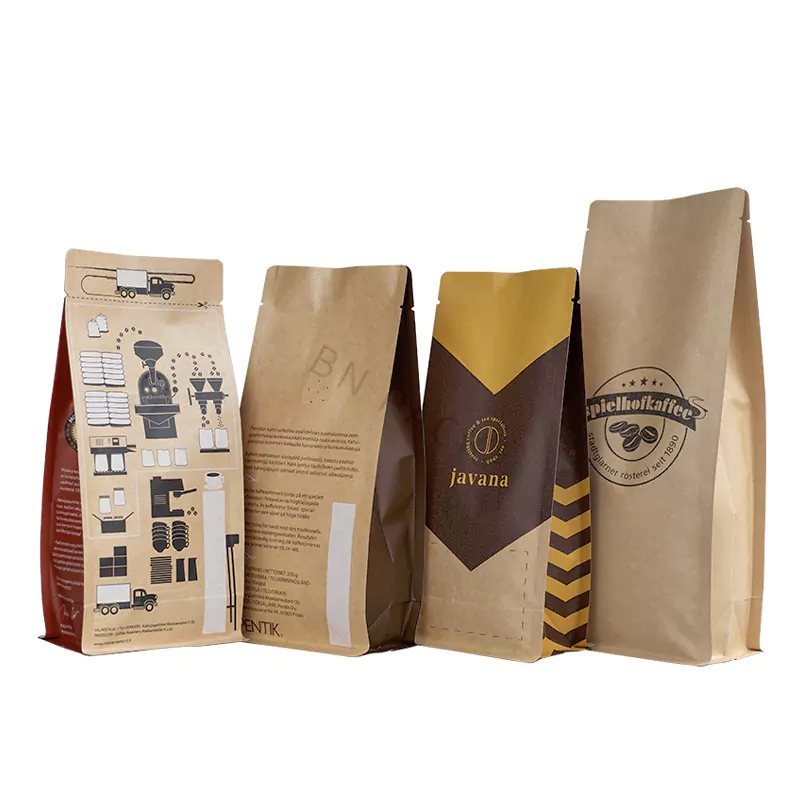
Yes, eco-friendly wholesale coffee packaging can fit a coffee business when material performance, order volume, disposal routes, and cost are checked together. In 2018, the U.S. EPA recorded 82.2 million tons of containers and packaging waste, equal to 28.1% of municipal solid waste generation. Yet a coffee pouch cannot be selected from waste data alone: roasted beans need protection from oxygen, moisture, light, and aroma loss. A recyclable PE pouch, compostable film, or paper-based bag may perform differently under heat sealing and storage. Businesses should compare OTR, WVTR, valve compatibility, MOQ, shelf life, and landed cost before changing packaging.
Coffee packaging has an unusual job because the product continues releasing carbon dioxide after roasting while also losing quality when exposed to oxygen. A one-way degassing valve allows internal gas to leave without leaving the package continuously open to outside air. For a roaster packing 100,000 bags per year, a material change of only 2 grams per bag changes annual material use by about 200 kg, so reducing film weight can matter even before changing the material family.
Barrier performance needs to come before appearance. Oxygen transmission rate, usually shown as OTR, measures how much oxygen passes through a material under stated test conditions, while WVTR measures water-vapor transmission. Two suppliers may quote different numbers because temperature, humidity, film thickness, and test methods differ, so a buyer should request the complete test conditions rather than comparing one number from each data sheet.
A bag described as “sustainable” can still be unsuitable for coffee if its oxygen barrier falls below the shelf-life requirement or its seals fail during transport.
Shelf-life requirements also vary by sales model. Coffee shipped to local subscribers within several days has a different storage period from coffee moving through a distributor and remaining on retail shelves for several months. If a roaster sells 40% online, 35% through cafés, and 25% through retail partners, one package specification may be oversized for one channel and underperform in another. Testing several structures against real storage periods gives more useful information than choosing the material with the strongest environmental wording.
Material structure comes next because a conventional coffee pouch may combine PET, PE, metallized film, aluminum, adhesives, inks, a zipper, and a valve. Multiple layers can provide strong barriers, yet combining polymers and foil can make recovery difficult. The Sustainable Packaging Coalition notes that flexible plastic packaging is still not recycled at scale in the United States and commonly depends on store drop-off or local collection systems rather than normal curbside recycling.
Mono-material pouches try to simplify that problem by keeping most of the package within one compatible polymer family, commonly polyethylene or polypropylene. The package still needs careful review because a thin barrier coating, incompatible zipper, valve, adhesive, or decorative layer may affect its recycling route. In 2018, the EPA estimated that the United States generated 14.5 million tons of plastic containers and packaging, around 5% of total municipal solid waste generation.
Paper-based formats need the same level of review. kraft paper coffee bags can provide the natural surface many specialty coffee brands want, but kraft paper alone normally does not provide the oxygen and moisture barrier required for roasted coffee. A commercial bag may therefore contain an inner polymer film, coating, metallized layer, or other barrier structure. Buyers should ask for the complete material specification rather than assuming the outside paper surface describes the whole package.
That distinction matters because paper performs very differently from flexible plastic after collection. EPA figures for 2018 show that paper and paperboard packaging reached 41.9 million tons of U.S. generation, while corrugated boxes recorded a recycling rate of 96.5%. Those figures should not be applied automatically to a laminated coffee pouch, since coatings, liners, adhesives, food residue, and mixed materials can change whether a local recovery facility accepts it.
Compostable films require another type of check. Industrially compostable packaging is generally designed for controlled conditions rather than ordinary soil or landfill disposal. Temperature, oxygen, moisture, microbial activity, and processing time are managed inside commercial composting systems. A customer with no access to an accepting facility may have no practical route for the package beyond general waste, so certification and local collection availability should be checked together.
Recycled-content films take a different approach because they reduce the share of virgin resin rather than promising a particular disposal route. The Sustainable Packaging Coalition reports that recycled PET may cost around 20% to 50% more than virgin PET under some market conditions because collection, sorting, processing, and demand affect supply. Recycled plastics can also show different strength, clarity, or barrier properties, which may require blending or additional layers.
Those material differences affect purchasing cost, but unit price alone gives an incomplete picture. A bag quoted at $0.18 may be less economical than a $0.21 alternative when the first supplier requires twice the inventory, higher freight, additional labels, more production waste, or a longer replenishment cycle. A business using 250,000 bags annually would see a $0.03 unit difference equal $7,500 before freight, storage, rejected bags, or setup charges are included.
| Purchase variable | What to compare |
|---|---|
| Material | Full layer structure, thickness, recycled content |
| Barrier | OTR, WVTR, test temperature and humidity |
| Closure | Zipper type, seal strength, reclosure performance |
| Valve | Material, position, degassing compatibility |
| Printing | Method, ink coverage, SKU quantity, setup cost |
| Volume | 10,000, 25,000, 50,000 and 100,000-unit pricing |
| Logistics | Carton quantity, pallet use, freight, lead time |
| Disposal | Accepted recycling or composting route |
Order quantity changes the economics further. A custom run of 10,000 units spreads printing setup and production preparation over far fewer bags than a run of 100,000. Larger orders can lower the price per pouch, but they also increase stored inventory. A company selling 20,000 bags per month would hold five months of stock after ordering 100,000 units; a design, address, certification, legal-text, or SKU change during that period can leave usable packaging commercially outdated.
Printing method also affects smaller brands with frequently changing coffees. Seasonal origins may remain available for only several months, making large preprinted runs less practical. A standard printed pouch combined with a smaller label for origin, roast date, lot, or tasting information can reduce unused inventory. Digital printing may support shorter runs than some conventional printing methods, although price, print quality, available films, ink systems, and finishing options vary by converter.
Packaging volume should match sales volume, not only the supplier’s lowest quoted price.
Equipment compatibility deserves the same attention because films do not all seal at the same temperature, pressure, or dwell time. A pouch that works during manual filling may behave differently on an automatic line producing thousands of units per shift. A 2% seal-failure rate sounds small, but across 200,000 annual packs it represents 4,000 units requiring rework, replacement, or disposal.
Testing should therefore include filled bags rather than empty samples alone. Check seal strength after 24 hours, zipper alignment, valve attachment, film cracking, print abrasion, drop performance, carton compression, and odor transfer. If the business ships through parcel carriers, packed products should be tested in the same cartons and quantities used for customer orders rather than evaluated only under warehouse conditions.
Regulation is becoming more relevant for brands selling across several markets. The European Union’s Packaging and Packaging Waste Regulation entered into force on February 11, 2025, with measures covering waste reduction, recyclability, reuse, consumer information, and secondary materials. Businesses selling into EU markets need packaging records that can support material and environmental claims instead of relying on broad terms such as “green” or “planet friendly.”
The United States also presents a practical collection issue. EPA data show that containers and packaging represented 28.1% of municipal solid waste generation in 2018, with an overall recycling rate of 53.9%, yet that number combines very different materials. Flexible plastic coffee pouches do not share the collection profile of corrugated boxes, steel cans, or glass containers, so a broad national recycling percentage should never be used to describe the recyclability of one coffee bag.
Supplier documentation can narrow the gap between marketing language and actual specifications. Before approving a large production run, ask for:
-
full material composition and thickness;
-
OTR and WVTR results with test conditions;
-
food-contact documentation for the target market;
-
recycled-content or compostability certification where claimed;
-
valve and zipper material specifications;
-
production tolerance and seal recommendations;
-
MOQ at several printing volumes;
-
sample and full-production lead times;
-
disposal instructions for the finished pouch, not only the main film.
Documentation becomes especially useful when several packaging claims appear on one bag. “Made with recycled content” does not say the package is recyclable, while “paper exterior” does not say the complete package belongs in a paper recycling stream. The Sustainable Packaging Coalition notes that consumers can confuse recycled-content and recyclable claims, so disposal wording should identify what the customer is actually expected to do with the empty package.
For a roaster using 500,000 pouches a year, even modest changes add up. Reducing package weight by 10% cuts the amount of primary packaging material purchased by roughly 10%, assuming the size and structure otherwise remain comparable. Reducing unnecessary bag dimensions may also place more units in each shipping carton, lowering carton consumption and freight space without changing the coffee itself.
The best-performing option is the one that protects the coffee for its required shelf life, works on existing packing equipment, fits realistic order volumes, and has a disposal route customers can actually use. Compare samples under real filling, shipping, and storage conditions before moving a full year of packaging volume to a new structure.